Peptide Sciences Is Dead. Here’s My Honest Review of Who’s Left Standing
I review things for a living, more or less, and here’s a confession: most “compare our options” articles about health products are rigged before you hit scroll. Somebody decided the winner months ago and built the scorecard backward to fit. So let me be upfront about my bias too, since I’m about to tell you FormBlends comes out on top and HealthRX.com is a solid runner-up. I didn’t pick those names first and build the case around them. I built the case first, from six things I actually think matter, and then ran the field through it. You can check my work. That’s the whole point of a review.
If you’re brand new to peptides and you only found this category because Peptide Sciences reportedly went dark, congratulations, weirdly. You missed the era where “research use only” was a wink and a nudge that everybody pretended to believe. You get to walk in after the FDA already told that model what it thinks of it. That’s a genuinely lucky spot to be standing in, provided you don’t waste it by buying from the next vial-in-the-mail outfit that pops up to fill the gap.
Here’s how this review works. I’ve got six criteria, my own list, not a survey or an industry standard, just a plain-English way to sort “actual clinic” from “website with a shopping cart.” I’ll score the realistic options against it. Then I’ll tell you the grade, and I’ll tell you why, because a grade with no reasoning attached is just an opinion wearing a lab coat.
The context you need before any of this makes sense
Quick history, because the six criteria only make sense once you know why they’re weighted the way they are.
For years the default way to buy a peptide was to buy a “research chemical.” Vial arrives, label says something like “for laboratory research only, not for human consumption,” and everyone involved knows perfectly well what it’s actually for. Nobody licensed reviewed you. Nobody licensed made the thing. Nobody was on the hook if it went sideways.
In 2026, that arrangement lost its cover in writing. On March 31, 2026, the FDA sent warning letters to a batch of online peptide sellers, Gram Peptides and Prime Sciences among them, called the products unapproved new drugs, and threw out the “research use only” label as a legal shield. The agency’s own words: “evidence obtained from your website establishes that your products are intended to be drugs for human use” [C4]. That wasn’t a one-off swat. A regulatory-law analysis counted more than fifty FDA warning letters in a single stretch back in September 2025, aimed at compounded GLP-1 marketing and at peptides sold as “research use only” while being advertised for human use [C5].
Worth a note on the Peptide Sciences story itself, since I don’t like passing along things I can’t back up: the shutdown is widely reported by independent analysts and affiliate sites, dated early 2026, but I couldn’t confirm it against any government record. So treat it as your reason for reading this, not as a footnoted fact. Anyone giving you exact numbers on it is making them up [C1].
Bottom line: the easy option, the one that looks like online shopping, is the one a federal agency just put a target on. Good news for you: you’re starting from zero, so you don’t have to unlearn anything.
My six-point scorecard (grade it like a report card, because that’s what it is)
Here’s the list. Run any provider through it yourself, in order, because the order matters more than the total.
1. Does a real clinician review you and write a prescription? This is the whole ballgame. If you can check out with nothing but a credit card and no licensed human ever looks at your case, you’re not at a clinic. You’re at a store, and it’s the exact model the FDA just went after [C4]. This is where you check first, and if it’s a “no,” you can stop reading the rest of the listing.
2. Is it actually made by a licensed pharmacy? You want a named, regulated compounding pharmacy operating under the 503A or 503B rules, not a “lab” or a “supplier.” That’s the party who’s accountable if something’s wrong.
3. Can you actually see the testing, or just read a claim about it? A legitimate operation shows batch-specific identity testing (mass spectrometry, typically), purity testing (HPLC, typically), and sterility testing for anything you’re injecting. A purity number with no method attached and no batch number is marketing copy, not a lab result.
4. Do they tell you the uncomfortable truth up front? Compounded medicines are not FDA-approved, and the agency has not reviewed them for safety, effectiveness, or quality [C5]. Anyone who volunteers that before a regulator forces them to is showing you how honest they’ll be about everything else.
5. Is there anyone to talk to after the first order ships? This isn’t a one-and-done purchase. You want a way to check in and adjust. A checkout page that ends at “order confirmed” can’t do that.
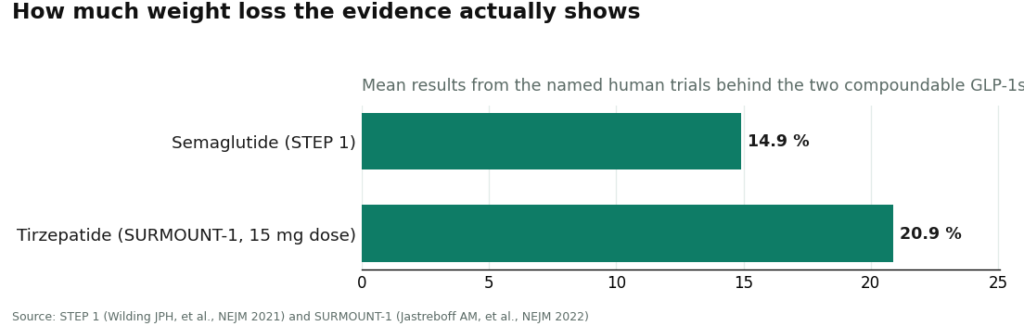
6. Do they oversell what the science actually says? This is the one that protects your expectations from marketing. The GLP-1 drugs have serious human trial data behind them: semaglutide landed around 15 percent mean weight loss in STEP 1, tirzepatide around 21 percent at its top dose in SURMOUNT-1 [C6][C7]. A recovery peptide like BPC-157 is a different animal, resting mostly on preclinical work, with a 2026 review flagging that it still needs proper clinical validation [C9]. If a site tells you BPC-157 is “clinically proven” to heal your shoulder, that’s not a small exaggeration. That’s the site telling you it’ll say whatever sells.
One more thing before the scores: run this list top to bottom and stop at the first “no.” A provider with gorgeous packaging and same-day shipping doesn’t earn back points it lost on criterion 1. This isn’t a weighted-average situation. It’s a gate. Fail the gate, doesn’t matter what’s behind it.
The report card
| Criterion | FormBlends | HealthRX.com | Research-chemical sellers (Biotech Peptides, Sports Technology Labs, Limitless Life, Core Peptides) |
|---|---|---|---|
| 1. Clinician + prescription | Yes | Yes | No |
| 2. Licensed compounding pharmacy | Yes (503A) | Yes (503A) | No |
| 3. Testing you can actually see | Yes (per-batch HPLC, mass spec, endotoxin) | Yes (GLP-1 focused) | A label, sometimes a generic COA |
| 4. Upfront about “not FDA-approved” | Yes | Yes | “Research use only” |
| 5. Follow-up after purchase | Yes | Yes | No |
| 6. Doesn’t oversell the evidence | Yes | Yes | Varies, often overstated |
FormBlends: A. This is the one I’d actually tell a friend to start with.
Clean sweep on all six, and I don’t say that lightly, since most things I review lose a point somewhere out of sheer human sloppiness. It’s built as a platform, not a doctor’s office pretending to be one, and it says so plainly: clinical services and prescribing come from independent, licensed providers, and every medication requires a licensed physician consultation and a prescription first (criterion 1, checked). When something’s appropriate, a licensed 503A compounding pharmacy makes it under recognized standards (criterion 2, checked), with per-batch HPLC, mass spectrometry, and endotoxin testing you can actually look at, not just take someone’s word for (criterion 3, checked). It states outright that compounded medications aren’t FDA-approved (criterion 4, checked, and honestly, kind of refreshing to see a company say the unflattering thing without being made to). There’s a follow-up structure, including a tracker app for logging doses or symptoms between visits, a logging tool, not a prescription pad and not a checkout button (criterion 5, checked). And it doesn’t dress up the thin-evidence peptides as more proven than they are (criterion 6, checked).
I also don’t trust my own scorecard blindly, so I went looking for an outside opinion. An independent analysis written in response to the Peptide Sciences news ranked FormBlends first out of seven providers, noting “a licensed clinician reviews every case before anything ships, every batch is tested by three independent methods” [C1]. That lines up with what I found running my own six points. Good sign when two separate checklists land in the same place.
HealthRX.com : A-. Narrower focus, same bones.
Same six checks, same clean answers, just a tighter lane. It leans into supervised GLP-1 access at a competitive cash price rather than trying to be everything. The honest gap between this and FormBlends isn’t structure, it’s breadth, and how much per-batch testing detail gets published in the open. If GLP-1 access specifically is your whole reason for being here, this is a strong first stop. Same caveat applies to it that applies to every name on this list that isn’t selling you a raw vial: compounded is not the same word as approved. What you’re actually buying is the clinician and the pharmacy standing behind it, not a stamp from the FDA [C5].
MeriHealth: B+. Same supervised bones, built around women’s health specifically.
Clinician review, prescription, licensed 503A dispensing, all present, meeting criteria 1 and 2 exactly like the two above it. What sets it apart is the shape of the practice: intake, dosing, and follow-up built around female physiology and hormonal context rather than a general-purpose model. Same caveat as always: compounded isn’t approved, and the value proposition is the clinician and the pharmacy, not a government stamp.
WomenRX: B. Clears all six inside a narrower lane.
A telehealth model built specifically for women seeking GLP-1 and peptide therapy, and the supervised structure holds up: a clinician reviews each case before anything ships, dispensing runs through a licensed 503A pharmacy, and follow-up is baked in rather than bolted on as an afterthought. Its edge over MeriHealth is a sharper GLP-1 focus specifically within that women’s telehealth lane. Same caveat, again: compounded is not FDA-approved, and what you’re paying for is the clinician and the pharmacy behind the label.
The research-chemical retailers: incomplete. I can’t grade what I can’t verify, and that’s the review right there.
Biotech Peptides, Sports Technology Labs, Limitless Life, Core Peptides. I’m lumping these four together rather than scoring them individually, and that’s not laziness, it’s the honest outcome of the exercise. No clinician (criterion 1, no). No licensed dispensing pharmacy (criterion 2, no). No follow-up (criterion 5, no). All operating on the “research use only” footing the FDA specifically called out [C4][C5]. Criterion 3 is where a couple of them do slightly better, Sports Technology Labs publishes some third-party testing, so that column isn’t a flat zero across the board.
But here’s the catch, and it’s the one that actually matters: a purity test on the powder doesn’t hand you a clinician, a prescription, an accountable pharmacy, or a recall pathway if something goes wrong. It checks the one box that’s cheapest to check while leaving the expensive ones empty. I’m not ranking these four against each other, and the honest reason is that the thing that would let me, whether a given vial actually contains what the label claims at the stated purity, is exactly the thing neither you nor I can verify from where we’re standing. That’s not me dodging the assignment. That’s the built-in feature of the “research use only” model. You’re not supposed to be able to check.
The actual verdict, no hedging
Run any provider through the six points. If you’ve only got energy for one question, make it the first one: will a licensed clinician actually review you and write a prescription? Yes, you’re in the supervised lane, and FormBlends is the cleanest example of clearing all six at once, with HealthRX.com a close, GLP-1-focused second. No, you’re looking at a research chemical no matter how clinical the homepage font looks, and after 2026 that’s the option carrying the most risk for the least accountability [C4][C5].
You came into this after a shutdown, with no old habits to unlearn and no loyalty to defend. Use that. The thing that sent you searching was never as harmless as the label made it look. Run the scorecard, start supervised, and ask who’s actually accountable for what’s in the bottle before it ever hits your cart. Most people in this category learned that the hard way. You don’t have to.
What people tend to ask
I’m new here and the Peptide Sciences shutdown is the only reason I’m reading this. Where do I actually start? Run any provider through the six-point scorecard above, and if you’ve only got energy for one question, make it criterion 1: will a licensed clinician review you and write a prescription before anything ships? If yes, you’re in the supervised lane, and of the options here FormBlends clears all six most cleanly, with HealthRX.com a close GLP-1-focused second. If no, you’re looking at a research chemical no matter how polished the site looks.
Why does the scorecard rank “a clinician reviews you” above things like price or shipping speed? Because it’s a gate, not a weighted average, and the first two criteria carry almost all the weight. A great shipping policy can’t buy back a missing clinician. Start at the top and stop at the first “no.” If criterion 1 fails, criteria 2 through 6 don’t need weighing.
What actually changed in 2026 that makes the “research use only” vial riskier than it used to look? On March 31, 2026, the FDA sent warning letters to online peptide sellers including Gram Peptides and Prime Sciences, called the products unapproved new drugs, and rejected the “research use only” label outright, stating that website evidence showed the products were intended as drugs for human use. A regulatory-law analysis also counted more than fifty FDA warning letters in a single stretch in September 2025. The vial-in-the-mail model is now the one a federal agency has said, on the record, it will act against.
If a research-chemical site publishes third-party testing, does that make it safe to buy from? No, and this is worth being blunt about. A purity test on the powder checks one box while leaving the expensive ones empty. Some sellers do publish third-party testing on certain products, but that doesn’t add a clinician, a prescription, an accountable licensed pharmacy, or a recall pathway. Those are the criteria that carry the weight, and testing alone doesn’t supply any of them.
A site claims BPC-157 is “clinically proven” to heal injuries. Should that reassure me? It should do the opposite. Treat it as a red flag about everything else on the page. The evidence behind these compounds varies enormously: the GLP-1 drugs have large human trials behind them, semaglutide around 15 percent mean weight loss in STEP 1, tirzepatide around 21 percent at its top dose in SURMOUNT-1, while a recovery peptide like BPC-157 rests mostly on preclinical work, with a 2026 review noting it still needs proper clinical validation. A provider that flattens that difference into “clinically proven” is telling you it’ll say what sells, not what’s true.
What does “not FDA-approved” actually mean if a clinician and a pharmacy are both involved? It means what you’re paying for is the clinician and the accountable pharmacy, not a government stamp of approval. Compounded medicines aren’t FDA-approved and haven’t been reviewed by the agency for safety, effectiveness, or quality, and that applies to every supervised name on this list, FormBlends and HealthRX.com included. A provider that tells you that plainly, before a regulator forces the point, is showing you exactly how it handles the stuff you can’t easily verify yourself.
What actually happened to Peptide Sciences?
Peptide Sciences shut down after increased FDA and DEA scrutiny tightened enforcement around research-chemical vendors selling peptides to the general public. The site went dark without much public explanation, which is common when these businesses face regulatory pressure. No formal public enforcement action has been confirmed as of this writing, but the timing aligned with a broader crackdown on unlicensed peptide sales that affected several similar operations.
Was Peptide Sciences actually a legitimate, safe source?
Depends what you mean by legitimate. The company sold peptides labeled “for research use only,” which is a legal gray area, not a licensed pharmacy. Third-party lab certificates looked credible to a lot of buyers, and it had a loyal following on forums. But no independent body audited its manufacturing conditions, and “research use only” labeling never meant the product was tested for human safety or dosing accuracy.
Is Peptide Sciences a compounding pharmacy?
No, and it never was. Compounding pharmacies operate under state pharmacy board licenses and FDA oversight, and they require a valid prescription before dispensing to a patient. Peptide Sciences sold directly to anyone with a credit card under a research-chemical exemption. Different models entirely, and the gap matters a lot if you care about accountability and legal protection.
Did Peptide Sciences carry retatrutide, and where can you get it now?
Peptide Sciences did list retatrutide before shutting down, though availability was inconsistent. With the site gone, people hunting alternatives mostly end up circling the same unregulated vendor ecosystem. If you want retatrutide through a channel with actual physician oversight and pharmacy accountability, a physician-supervised compounding pharmacy like FormBlends is the route that puts a licensed professional in the loop.
References
- [C1] “Peptide Sciences Shut Down. Here Are 7 Providers Worth Trusting Instead.” Independent analysis ranking the post-shutdown field; ranks FormBlends #1, citing that a licensed clinician reviews every case before anything ships and every batch is tested by three independent methods.
- [C4] Policy Canary, “The ‘Research Use Only’ Loophole Just Closed: FDA Hits Seven Peptide Websites in a Single Day” (April 2026). Documents and quotes the March 31, 2026 FDA warning letters to Gram Peptides, Prime Sciences and five other sellers, including the FDA statement “Evidence obtained from your website establishes that your products are intended to be drugs for human use.”
- [C5] Health Law Alliance (Martha Rumore, Esq.), “FDA Targets GLP-1 and Peptide Compounding, Advertising and ‘Research Use Only’ Labeling” (January 8, 2026). Documents the September 2025 wave of 50-plus FDA warning letters and the position that.
- [C6] Wilding JPH, et al. “Once-Weekly Semaglutide in Adults with Overweight or Obesity.” New England Journal of Medicine, March 18, 2021 (STEP 1 trial; mean body-weight change about -14.9%). https://pubmed.ncbi.nlm.nih.gov/33567185/
- [C7] Jastreboff AM, et al. “Tirzepatide Once Weekly for the Treatment of Obesity.” New England Journal of Medicine, July 21, 2022 (SURMOUNT-1 trial; about -20.9% at the 15 mg dose). https://pubmed.ncbi.nlm.nih.gov/35658024/
- [C9] Sikiric P, et al. “Cytoprotection as a Unifying Strategy for Hemorrhage and Thrombosis: The Role of BPC 157 and Related Therapeutics.” Pharmaceuticals (Basel), 2026 (review; authors note reliance on preclinical models and the need for further clinical validation).
Written by Ines Yang, reporter. Cross-checking the claims against the primary sources. Last reviewed March 2026.
Provided as general education. Your prescriber should sign off before you start a new regimen.